
Architecture
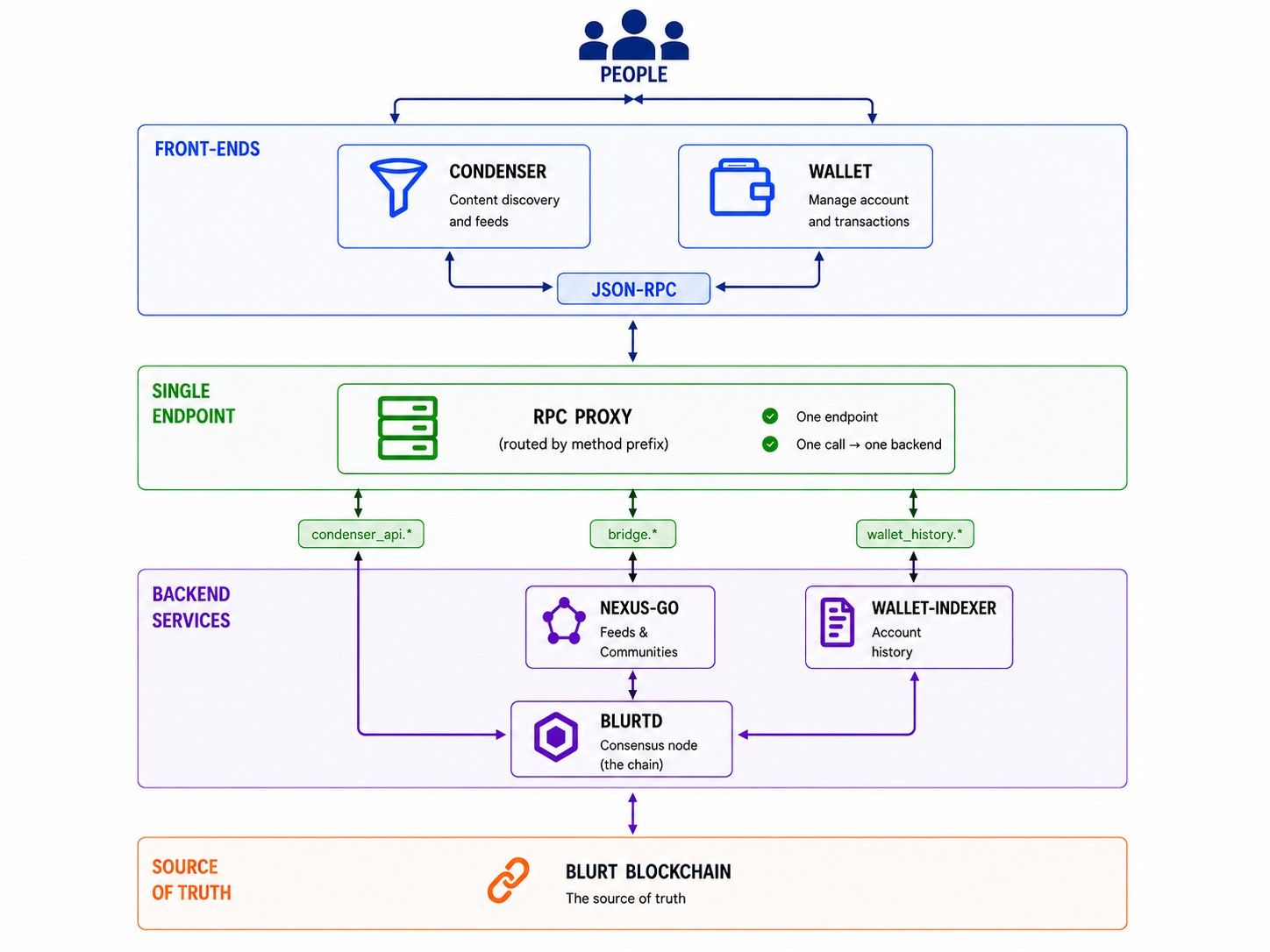
The stack is layered: the blockchain as the source of truth at the bottom, a node that serves it, backend services derived from it, a single RPC endpoint in front, and the front-ends on top.
Two indexers, don't confuse them
The wallet-indexer is the standalone service that answers wallet_history.* (account history). nexus-go has its own internal indexer that builds feeds and communities — it lives inside nexus-go, not as a separate component, and is documented under nexus-go.
The layers
- Source of truth — the Blurt blockchain: the decentralized ledger. No single machine is the chain; the network is.
- Node — blurtd: a consensus node that validates the chain and serves it over JSON-RPC. Everything above reaches the chain through a blurtd node.
- Backend services — read the chain (through blurtd) and serve derived data:
- nexus-go — feeds, threads and communities (the
bridgeAPI). - wallet-indexer — fast account / wallet history.
- nexus-go — feeds, threads and communities (the
- RPC proxy — one JSON-RPC endpoint, routing each call by method prefix:
condenser_api.*→ blurtd,bridge.*→ nexus-go,wallet_history.*→ wallet-indexer. - Front-ends — condenser (web) and the wallet — call that one endpoint and render the result.
How a read flows
- A front-end calls the RPC proxy — the same endpoint it uses for everything.
- The proxy routes each call by method prefix to a blurtd node, nexus-go or the wallet-indexer.
- That backend answers — from the chain (via blurtd) or from its own index — and the front-end renders the result. One endpoint, so a front-end needs no special configuration per service.
How a write flows
Posting, transferring, or voting is a signed transaction broadcast to a blurtd node, which propagates it to the network. Once it lands in an irreversible block the backend services pick it up: nexus-go threads it into feeds and communities (through its own internal indexer), the wallet-indexer records the wallet-relevant parts, and the front-ends show it.